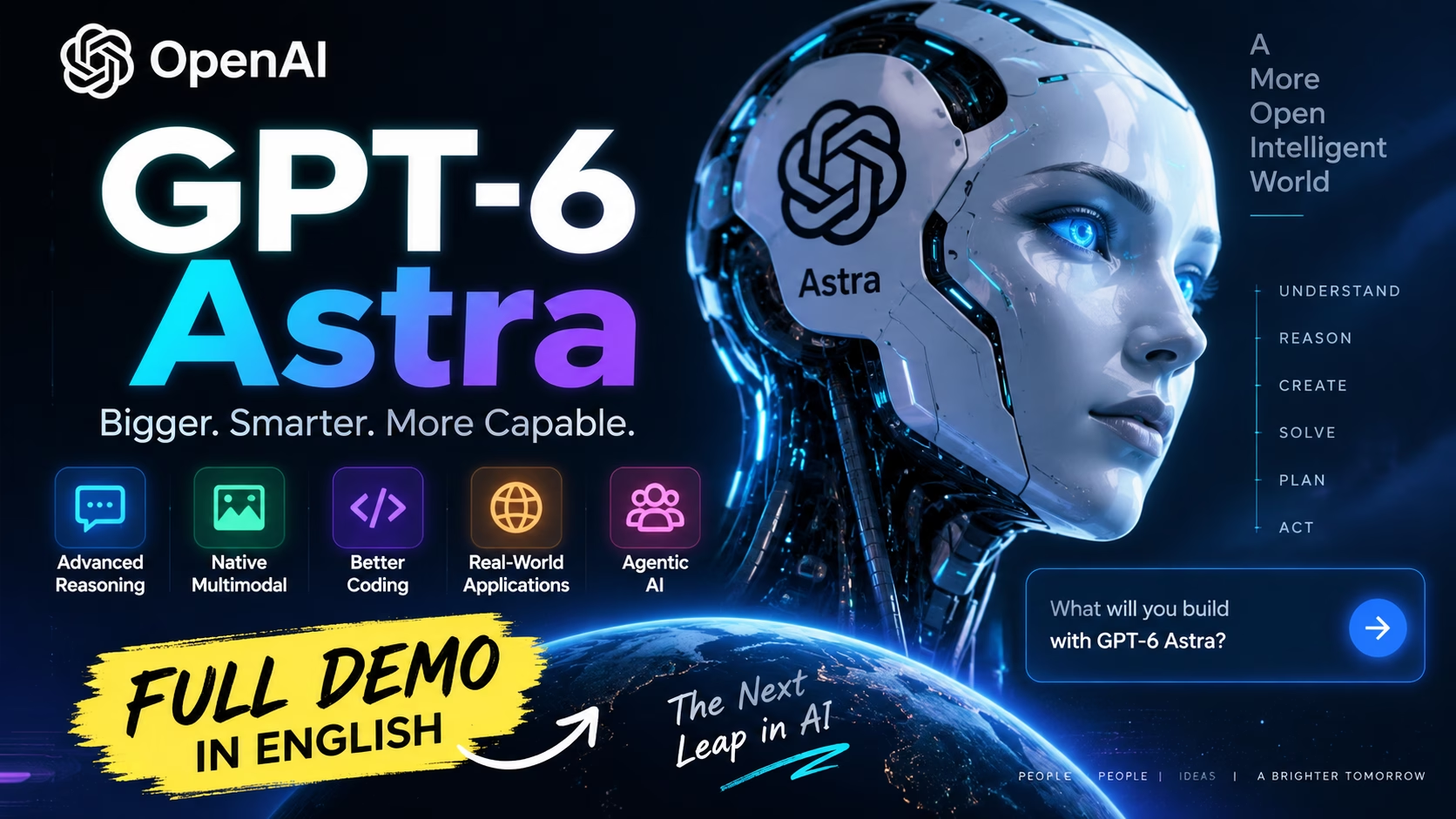
The biggest idea in this demo is not simply “a smarter model.” It is a shift from asking AI for answers to assigning AI an objective, letting it work through multiple steps, use software, inspect results, and return something closer to finished work.
The big takeaway: AI is moving from answers toward outcomes
The strongest message in the demo is that the next generation of AI is being positioned as more than a text generator. Instead of repeatedly writing a prompt, copying the answer, opening another tool and manually connecting every step, the user can increasingly describe the desired outcome and supervise a longer workflow.
Understand
Interpret the objective, context and constraints instead of responding only to one isolated prompt.
Act
Move through multiple steps, information sources and software as part of one connected task.
Deliver
Return something closer to a usable brief, website, analysis or other finished output.
From chatbot to AI coworker
The interface shown in the demo supports a broader idea: AI is becoming more like a workspace where an objective can be turned into visible activity steps. This is very different from the traditional ask → answer → copy → repeat pattern.
In simple terms, the workflow becomes goal → execution → supervision → outcome. That is why the “agentic” direction shown in the video matters more than another incremental improvement in ordinary chatbot responses.
What the demo actually shows
The video focuses heavily on a practical website-building demonstration. The creator uses an advanced AI coding environment, selects the Astra model and gives it a broad objective: create a polished, production-quality interactive educational website about the model and its capabilities.
The interesting part is not just that code is generated. The demo presents the AI as taking a larger share of the work: interpreting the brief, building the experience and producing something that can be demonstrated as a coherent result. The video also highlights long-context and agentic-work capabilities.

The benchmark story: impressive, but context matters
The presentation highlights headline evaluation scores around abstract reasoning, advanced mathematics and cybersecurity. Those numbers can be useful signals of technical capability, but they should not be interpreted as a guarantee that an AI system will be correct in every real-world situation.
Headline evaluation figures shown in the demo
| What a high score suggests | Why it matters | What it does not automatically prove |
|---|---|---|
| Strong performance on a defined evaluation | Capability may be improving in difficult domains | Perfect reliability in every open-ended task |
| Strong abstract reasoning performance | Better adaptation to unfamiliar problems | Human-level understanding in every context |
| Strong technical security performance | Advanced technical capability | Safe behavior without appropriate controls |

The research and execution workflow is the most important idea
For many professionals, the most practical part of this direction is not the benchmark page. It is the possibility of delegating a sequence of connected tasks: understand the objective, plan the work, gather information, compare claims, check evidence and prepare the final output.
| Step | What the AI workflow can do | Human responsibility |
|---|---|---|
| Understand objective | Interpret the requested outcome and context | Define what success actually means |
| Plan work | Create a path for the task | Set priorities and boundaries |
| Gather information | Collect relevant material and context | Review important source quality |
| Compare claims | Identify agreement, disagreement and gaps | Make judgment calls on ambiguity |
| Prepare output | Package the work into a usable artifact | Approve and remain accountable |
This is where the conversation connects naturally with the fundamentals of machine learning. Machine learning helps systems recognize patterns and generate useful outputs from learned structure. Agentic workflows add another layer: using that capability to sequence actions toward a larger objective.

Why this could change how people use AI
Less tool switching
Connected workflows can reduce the friction of manually moving information between research, documents, code and other tools.
Longer task continuity
The AI can stay focused on a broader objective while incorporating follow-up instructions and new context.
More finished outputs
The value can shift from generating a draft to helping create something closer to an immediately usable deliverable.
If you are still building the fundamentals, it helps to step back and understand what artificial intelligence actually is. GPT-style systems are one part of the wider AI landscape. The next step shown in demos like this is the tighter combination of intelligence, tools, context and task execution.

What to be careful about before calling this fully autonomous intelligence
✓ What is genuinely exciting
- Longer multi-step task execution
- Better integration with professional workflows
- More structured and polished outputs
- Potentially less repetitive manual work
- More natural interaction through tools and context
⚠ What still requires caution
- Benchmarks are not universal real-world reliability
- AI can still produce plausible but incorrect information
- Tool access increases the consequences of mistakes
- High-stakes decisions still need verification
- Autonomy does not remove human accountability

My interpretation of the demo
The “insane” part is not that AI can write another paragraph or generate another block of code. The more important development is the possibility that AI starts occupying the middle layer of work: opening tools, organizing information, keeping track of objectives, building outputs and helping push a task toward completion.
FAQ
Is this direction different from a normal chatbot?
Yes. The main difference is the emphasis on longer workflows, tools, software interaction and producing a connected final result rather than answering one message at a time.
Do high benchmark scores mean AI is always right?
No. A benchmark measures performance under a defined evaluation. Real-world tasks can contain ambiguity, unreliable information and constraints that do not exist in a benchmark.
Will this replace every professional?
The more immediate impact is likely to be task transformation. People may delegate larger portions of research, drafting, coding and software operation while remaining responsible for objectives, judgment and important decisions.