You have probably used AI today without even thinking about it. That spam filter in your email? AI. The playlist your music app made just for you? AI again. The autocorrect that saved you from sending “ducking” to your boss? Yeah, that too.
But when someone says “artificial intelligence,” a lot of us still picture robots from sci-fi movies or some distant future. The reality is far more ordinary and way more interesting. AI is already woven into how we text, shop, study, scroll, and work. You do not need a computer science degree to understand what is going on under the hood. You just need someone to explain it without the jargon.
That is exactly what this guide does. We are going to break down what AI actually is, how it works in plain language, where you already interact with it, and what you should know before trusting it too much.
So What Exactly Is Artificial Intelligence?
Artificial intelligence, or AI, is a branch of computer science focused on building systems that can do things that normally require human intelligence. That includes recognizing patterns, understanding language, making decisions, solving problems, and even being creative.
Think of it this way: a traditional computer program follows a strict set of instructions. If you tell it to calculate 2 + 2, it gives you 4 every single time. An AI system is different. It learns from examples and data instead of being programmed step by step for every possible scenario. You do not write a rule for every cat photo. You show the system thousands of cat photos, and it figures out the pattern of what makes a cat a cat.
That ability to learn from data is the secret sauce. And it is not magic. It is math, statistics, and a lot of clever engineering.
AI Is Not Just One Thing
People throw around the term “AI” like it is a single invention, but it is actually a whole toolbox of different techniques and approaches. Here is a simple way to break it down:
- Machine learning is the most common approach. Instead of being explicitly programmed, systems learn patterns from data. This is the foundation of most AI you see today.
- Deep learning is a subset of machine learning that uses layered neural networks. It powers things like image recognition, voice assistants, and large language models.
- Natural language processing (NLP) helps AI understand and generate human language. Your phone’s voice assistant and ChatGPT both rely on NLP.
- Computer vision lets AI interpret images and videos. Face unlock on your phone, medical scan analysis, and self-driving car cameras all depend on this.
- Generative AI creates new content like text, images, music, and code based on patterns it has learned. This is the category behind tools like ChatGPT, Midjourney, and DALL-E.
Quick breakdown: All deep learning is machine learning, but not all machine learning is deep learning. All generative AI is AI, but not all AI is generative. Think of AI as the umbrella term, with more specialized tools underneath it.
If you want to really understand the engine driving most of today’s AI, it is worth checking out What Is Machine Learning? A Complete Beginner’s Guide. It goes deeper into how these systems actually learn from data, explained without the usual textbook fog.
How Does AI Actually Work? A Simple Mental Model
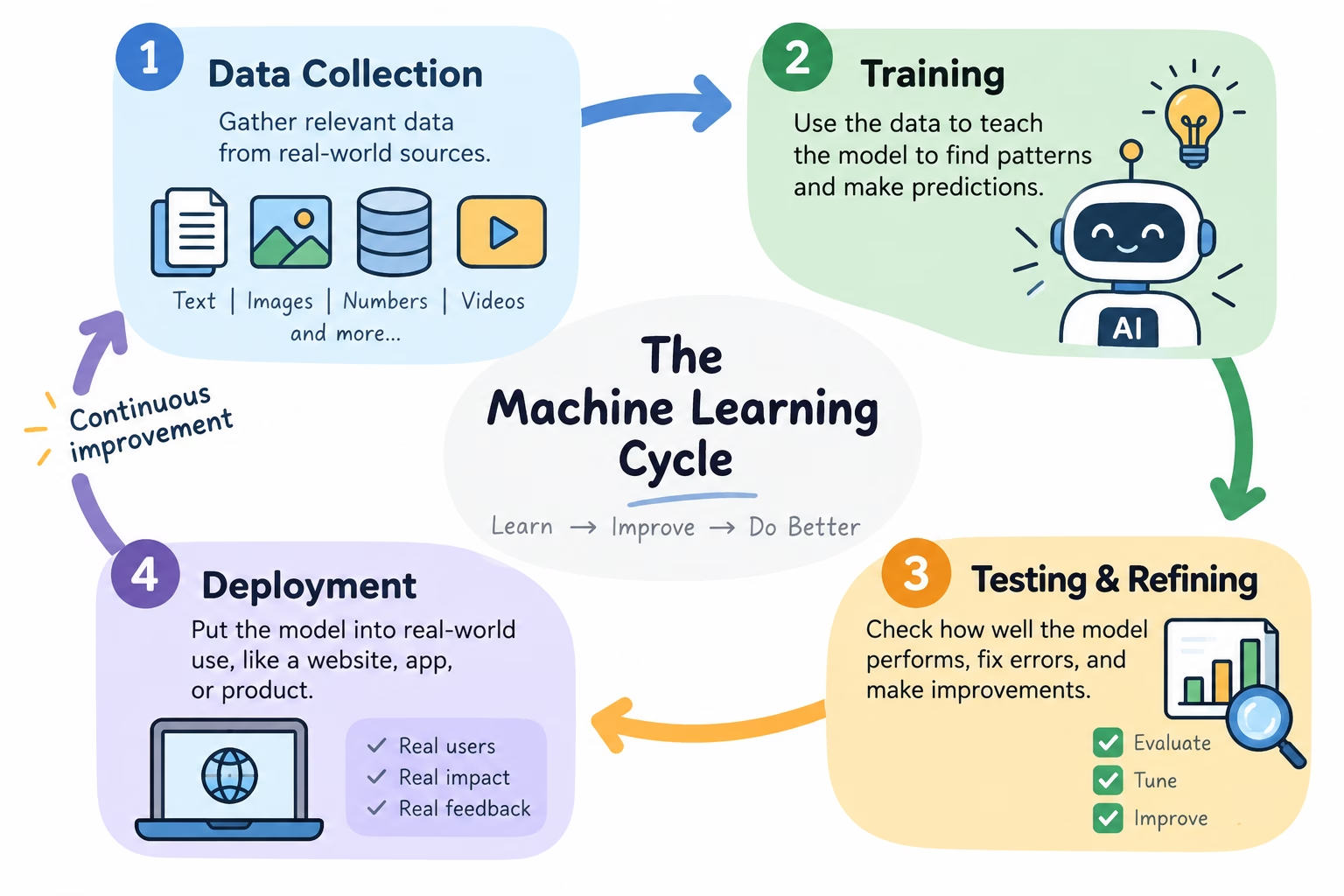
Let us use a relatable example. Imagine you want to teach a computer to recognize whether a photo contains a dog or a cat. Here is the core process:
- Collect data. You gather thousands of labeled photos: “this is a dog” and “this is a cat.”
- Train the model. You feed those photos into a machine learning algorithm. The algorithm looks for patterns: dogs tend to have certain ear shapes, cat faces have different proportions, and so on.
- Test and refine. You show the model new photos it has never seen. If it gets most of them right, great. If not, you give it more data or tweak the algorithm.
- Deploy and keep learning. The trained model goes into an app or service. In many cases, it keeps learning from new interactions, getting better over time.
This is a simplified picture, but it captures the core idea: AI learns patterns from examples, then applies those patterns to new situations. It is not “thinking” like a human. It is making statistical predictions based on what it has seen before.
What AI Is Good At (and What It Sucks At)
AI is genuinely impressive, but it has very specific strengths and weaknesses. Knowing the difference helps you use it wisely.
| AI Is Great At | AI Struggles With |
|---|---|
| Processing huge amounts of data fast | Understanding context beyond its training data |
| Spotting patterns humans might miss | Common sense reasoning |
| Repetitive tasks without getting bored | Understanding emotions and nuance |
| Generating text, images, and code quickly | Being accurate 100% of the time |
That last row is important. AI can sound incredibly confident while being completely wrong. We will come back to that.
Where You Already Use AI Every Day
You probably interact with AI dozens of times before lunch. Here are some examples that might make you go “oh, right, that is AI too.”
- Text predictions and autocorrect on your phone keyboard. The suggestions for your next word are powered by language models trained on billions of words.
- Spam filters in Gmail, Outlook, and other email services. They learn what spam looks like based on millions of flagged messages.
- Streaming recommendations on Netflix, Spotify, and YouTube. The “because you watched” section is an AI system matching your taste patterns with others.
- Face unlock on your iPhone or Android. Computer vision maps your facial features in milliseconds to verify it is really you.
- Voice assistants like Siri, Alexa, and Google Assistant. They convert your speech to text, interpret the meaning, and respond using NLP.
- Navigation apps like Google Maps and Waze. They analyze traffic patterns in real time to suggest the fastest route.
- Social media feeds on TikTok, Instagram, and X. The algorithm curates what you see based on your scrolling behavior, watch time, and engagement.
- Fraud detection on your credit card. Banks use AI to flag unusual transactions instantly.
Generative AI: The New Kid Everyone Is Talking About
Over the last few years, generative AI has exploded into public consciousness. Tools like ChatGPT, Google Gemini, Midjourney, DALL-E, and Claude can produce original-looking text, images, music, and code in seconds. It feels like magic, but the reality is a bit more grounded.
Generative AI models are trained on enormous datasets. A text model like ChatGPT has read a significant chunk of the public internet. A image model like Midjourney has studied millions of images paired with text descriptions. When you give these tools a prompt, they generate something new by predicting what comes next based on those patterns.
It is important to understand that these tools do not “know” things the way you do. They do not have beliefs, opinions, or lived experience. They are very sophisticated pattern-matching machines that can produce convincing output. Sometimes that output is brilliant. Sometimes it is confidently wrong. That leads us to one of the most important things to understand about AI.
The Big Problem: AI Hallucinations and Bias
Here is the thing nobody likes to talk about at launch events: AI makes mistakes. A lot of them. And it can be really convincing while doing so.
What Are AI Hallucinations?
When an AI model generates false or misleading information but presents it as if it were true, that is called a hallucination. For example, you might ask a chatbot for a list of sources about a topic, and it will give you perfectly formatted citations for books and articles that do not exist. It is not lying on purpose. It is predicting what a good answer should look like based on its training data, and sometimes it fills in the gaps with plausible-sounding fiction.
“Think of an AI hallucination like a friend who always has an answer, even when they are not sure. The confidence is there, but the facts might not be.”
This matters a lot when you are using AI for homework, research, or anything where accuracy is important. Always double-check important claims with reliable, human-verified sources.
Bias Is Built In
AI systems learn from data created by humans, and humans are biased. If a hiring algorithm is trained on historical data where most successful candidates were men, it might unfairly favor male applicants. If a face recognition system is trained mostly on lighter-skinned faces, it may perform worse on darker-skinned people. These are real problems that researchers and companies are actively working on, but they have not been fully solved.
This does not mean AI is evil or useless. It means you should use it thoughtfully. Question the output. Ask where the data came from. Recognize that AI reflects the world it was trained on, including the messy parts.
Can You Learn AI Without a Tech Background?
Yes. Absolutely. You do not need to be a math genius or a programmer to understand how AI affects your life or to use AI tools effectively. In fact, knowing how to work with AI is becoming a practical skill for almost every field, from marketing to medicine to music.
Here is a realistic way to start:
- Use AI tools regularly. Experiment with ChatGPT, Google Gemini, or other chatbots. Try asking them to summarize articles, brainstorm ideas, or explain a concept in simple terms.
- Learn the basic vocabulary. Understand what “model,” “training data,” “prompt,” and “hallucination” mean. This guide is a start.
- Read beginner-friendly resources. The Hanjuth AI knowledge base is built exactly for this. Start with topics that interest you and build from there.
- Practice critical thinking. When you get an AI-generated answer, ask yourself: Does this make sense? Can I verify it somewhere else? What might be missing?
- Join communities. Discord servers, Reddit forums, and local meetups about AI are full of people figuring it out together. You do not need to go it alone.
Common Myths About AI Worth Busting
AI has been around since the 1950s, but the recent wave of generative tools has created a lot of confusion. Let us clear up some of the most persistent myths.
| Myth | Reality |
|---|---|
| AI is conscious or sentient | No. AI has no feelings, awareness, or subjective experience. It is pattern matching, not thinking. |
| AI will replace all human jobs | AI will change many jobs, but it also creates new ones. History shows technology often shifts work rather than eliminating it entirely. |
| AI is always objective and fair | AI reflects the biases in its training data. It can be as biased as the humans who created that data. |
| AI is a new invention | The field has existed for over 70 years. What is new is the scale of data, computing power, and accessibility. |
What Should You Actually Care About Right Now?
You do not need to become an AI expert overnight. But you do need to be AI-literate. That means understanding enough to use these tools effectively, spot potential problems, and make informed choices about how you engage with AI in your own life.
Here are three practical things you can start doing today:
- Use AI as a thinking partner, not a shortcut to avoid thinking. Let it help you brainstorm, outline, or explain something complicated. But do the final thinking yourself.
- Protect your personal information. Be mindful of what you share with AI tools. Many services use your prompts and interactions to improve their models unless you opt out.
- Stay curious. AI is evolving fast. The tools you use today may look completely different in a year. Following reliable sources and learning the basics now will keep you ahead of the curve.
Want to learn more about AI in plain, friendly language?
Browse the full collection of beginner-focused guides at Explore AI Knowledge. Whether you are curious about machine learning, neural networks, or how AI affects creativity, there is something there for you.
Got a specific question? Just ask it. Ask Hanjuth AI Anything and get an answer that actually makes sense.