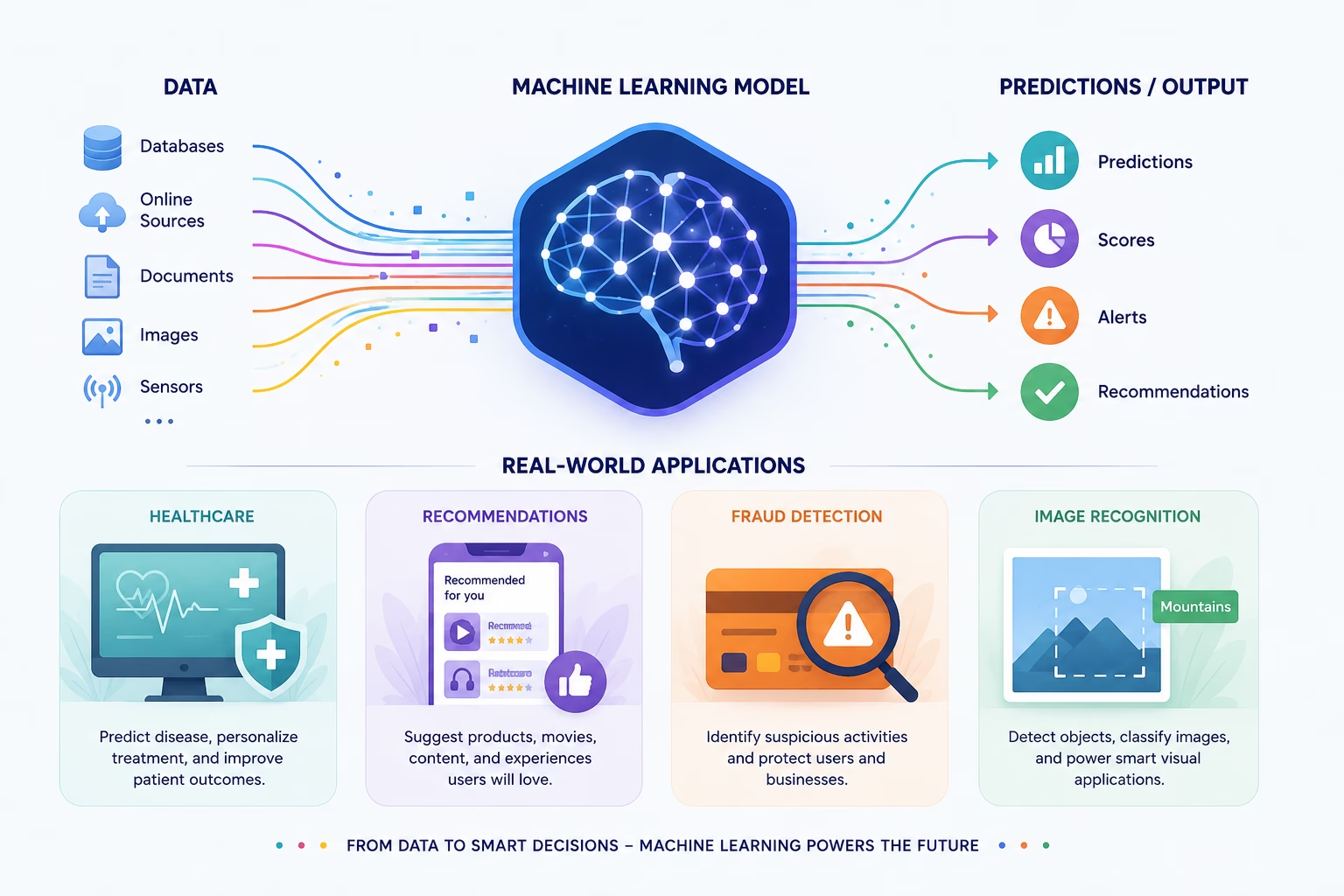
Think about the last time your email service quietly moved a suspicious message into the spam folder without you lifting a finger. Or the moment a streaming platform somehow knew you would enjoy a show you had never heard of. These everyday experiences share something in common. They are powered by systems that have learned from patterns in data rather than being explicitly told what to do.
Most of us interact with machine learning dozens of times a day without ever thinking about it. The technology sits behind search results, voice assistants, fraud alerts, and translation tools. But what exactly is happening under the hood? How does a computer, which is fundamentally just a machine that follows instructions, manage to “learn” anything at all?
That is the question at the heart of this guide. We will explore what machine learning is, how it works, the main types of ML, and why understanding its limitations is just as important as appreciating what it can do.
What Is Machine Learning?
Machine learning is a branch of artificial intelligence that enables computer systems to learn patterns from data and then use those patterns to make predictions, classifications, or decisions without being explicitly programmed for every possible scenario. In other words, the system improves its performance on a task by examining examples rather than by following a fixed set of hand-written rules.
To understand what makes this approach different, it helps to contrast it with traditional programming. In a conventional program, a developer writes explicit instructions. The program receives input data and applies those instructions to produce an answer. For example, a traditional email filtering system might use rules like “if the subject line contains the word ‘free’ and the sender is unknown, mark as spam.” Every rule has to be thought up and coded by a human.
Machine learning flips this process around. Instead of writing rules, you provide the system with many examples of the desired behavior. The system then works out the underlying patterns on its own. The result is a trained model, a mathematical representation of those learned patterns, that can be applied to new, unseen data.
The comparison looks something like this:
Traditional programming: Rules + Data → Answer
Machine learning: Data + Known Examples → Model
Once a model has been trained, it can take new inputs and produce outputs. A spam detection model, for instance, can look at an email it has never seen and estimate whether that email is likely to be spam. It does not need a human to write a rule for every possible phrase or sender. It has learned the characteristics of spam from thousands of labeled examples.
Machine Learning vs Artificial Intelligence
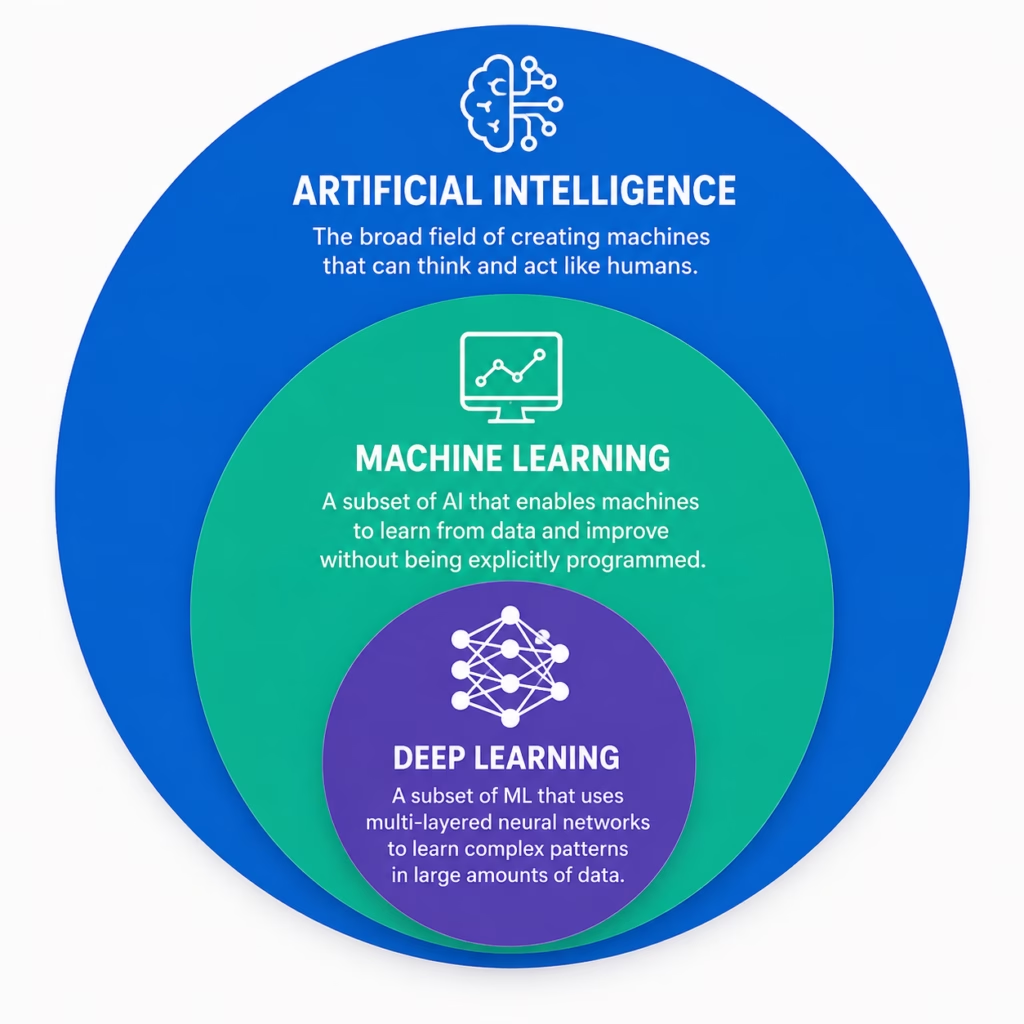
Artificial intelligence is the broader field concerned with building computer systems that can perform tasks that normally require human intelligence, such as understanding language, recognizing images, making decisions, or solving problems. Machine learning is one approach within that larger field, and it is currently the most widely used one.
Not every AI system relies on machine learning. Early AI research included rule-based expert systems, where human specialists painstakingly encoded domain knowledge into if-then rules. A medical diagnostic system from the 1980s, for example, might have used thousands of hand-written rules about symptoms and diseases. That is AI without ML. However, modern AI systems frequently use machine learning because it scales far better to complex, messy real-world data. For a deeper look at this broader topic, you can read What Is Artificial Intelligence? A Complete Guide to AI.
The relationship is straightforward: machine learning is a subset of artificial intelligence. Deep learning, which we will discuss later, is in turn a subset of machine learning. Understanding this hierarchy helps clarify a lot of confusing technology writing.
A Brief History of Machine Learning
The idea of machines that can learn is older than many people realize. One of the most frequently cited early milestones involves Arthur Samuel, a pioneer at IBM. In the 1950s, Samuel built a computer program that could play checkers. Crucially, the program improved over time by playing against itself and learning which moves led to better outcomes. Samuel coined the term “machine learning” in 1959 to describe this approach.
For decades after Samuel’s work, the field progressed in fits and starts. Researchers developed important algorithms, but practical applications were limited by slow processors, expensive memory, and a scarcity of digital data. The fundamental ideas were sound. The infrastructure to apply them at scale was not yet there.
That changed dramatically as computing power became cheaper, storage capacity exploded, and the internet generated enormous volumes of data. The algorithms that had been studied for years could suddenly be trained on datasets of unprecedented size. This convergence of data, computing power, and refined algorithms is what pushed machine learning from an academic curiosity into the mainstream technology it is today.
How Does Machine Learning Work?
At a high level, the machine learning process follows a predictable sequence. Different projects may emphasize some steps more than others, but the general flow looks like this:
1. Collecting data. Everything starts with data. A spam filtering system needs examples of spam and legitimate emails. A house price predictor needs historical records of property sales.
2. Preparing and cleaning the data. Raw data is rarely ready to use. It may contain missing values, duplicate entries, inconsistent formatting, or outright errors. Cleaning and preprocessing typically consumes a large portion of a data scientist’s time.
3. Selecting relevant features. Features are the individual measurable properties or characteristics used as inputs. For a house price model, features might include square footage, number of bedrooms, location, and year built. Choosing the right features has a significant impact on performance.
4. Choosing a model or algorithm. Different problems call for different approaches. A simple linear model may work well for one task, while a neural network may be more appropriate for another.
5. Training the model. During training, the algorithm processes the data and adjusts its internal parameters to minimize errors. This is where the “learning” happens.
6. Evaluating performance. Once trained, the model is tested on data it has not seen during training. This provides an honest measure of how well it generalizes.
7. Testing with unseen data. A separate test set helps confirm that the model has not simply memorized the training examples.
8. Deployment and inference. After evaluation, the model is deployed into a real-world environment where it makes predictions on new inputs. This is called inference.
9. Monitoring and improving. Real-world data changes over time. A model trained on last year’s email patterns may become less effective as spammers change tactics. Ongoing monitoring and periodic retraining are essential.
The ultimate goal of all these steps is generalization. A model that only performs well on its training data is useless. The entire point is to build a system that can handle new, previously unseen examples with reasonable accuracy.
The Main Types of Machine Learning
Machine learning approaches are generally grouped into three broad categories based on how they learn from data.
Supervised Learning
Supervised learning is the most common type of machine learning. The system is trained on labeled data, meaning each training example comes with the correct answer attached. Think of it as a student practicing with an answer key. After enough practice, the student can solve similar problems without the key.
Supervised learning tasks fall into two main buckets. Classification involves predicting a category or label, such as “spam” or “not spam,” “fraudulent” or “legitimate,” “cat” or “dog.” Regression involves predicting a continuous numerical value, such as a house price, a temperature forecast, or a customer’s likely spending amount.
Practical examples of supervised learning include spam detection, house price prediction, image classification, and fraud detection. In each case, the model learns from historical examples where the outcome was already known.
Unsupervised Learning
Unsupervised learning works with unlabeled data. There is no answer key. The system looks for patterns, groupings, or structures on its own. This is useful when you have a large amount of data but do not know exactly what you are looking for.
The most common unsupervised technique is clustering, where the algorithm groups similar data points together. A retailer might use clustering to identify distinct customer segments based on purchasing behavior. Another application is anomaly detection, where the system flags unusual patterns that deviate from the norm, which can be useful for detecting network intrusions or unusual financial activity.
Reinforcement Learning
Reinforcement learning takes a different approach entirely. Instead of learning from labeled examples or finding hidden structures, the system learns through trial and error. An agent interacts with an environment, takes actions, and receives rewards or penalties based on the outcomes. Over time, the agent learns which actions tend to produce the best long-term results.
Game-playing systems have been a prominent testing ground for reinforcement learning. A program can learn to play chess, Go, or video games by playing millions of matches and adjusting its strategy based on wins and losses. The same principles apply to robotics, where a robot arm might learn to grasp objects through repeated attempts, and to decision-making environments like dynamic pricing or resource allocation.
It is worth noting that reinforcement learning is not the foundation of all modern AI, even though it has received considerable media attention. Many practical machine learning applications rely on supervised or unsupervised approaches.
What Are Machine Learning Models?
A machine learning model is, in essence, a mathematical or computational system that has learned relationships from training data. It is not a physical object. It is a structured representation of patterns, often stored as a set of parameters or weights, that can be applied to new inputs to produce predictions.
Think of a model as a simplified map of a territory. The map is not the territory itself, but it captures the essential features needed to navigate. Similarly, a machine learning model captures the essential patterns in data without storing every original example.
Different problems call for different model types. Some commonly used models include:
Linear regression predicts a continuous value based on a linear relationship between inputs and outputs. It is simple but surprisingly useful for many problems.
Decision trees make predictions by following a series of branching decisions. They are easy to interpret, which makes them valuable in fields where explainability matters.
Random forests combine many decision trees to produce more robust predictions by reducing the tendency of individual trees to overfit.
Neural networks are more complex models inspired loosely by the structure of biological brains. They excel at processing unstructured data such as images, audio, and text.
The choice of model depends on the problem, the size and type of data, the need for interpretability, and the available computational resources. There is no single “best” model for every task.
Machine Learning vs Deep Learning
Deep learning is a subset of machine learning that uses neural networks with many layers. These deep networks can learn highly complex patterns by building up representations of data level by level. For example, in image recognition, early layers might detect edges, middle layers might detect shapes, and deeper layers might recognize full objects.
Deep learning has been particularly transformative for tasks involving images, speech, natural language, and large-scale pattern recognition. The systems that power modern voice assistants, automatic photo tagging, and language translation often rely on deep learning models.
However, deep learning is not automatically better than every other machine learning technique. Deep models typically require large amounts of data and substantial computational resources to train effectively. For many problems, especially those involving smaller datasets or tabular data, simpler models like random forests or gradient boosting can perform just as well or better while being easier to train and interpret.
The right approach is the one that fits the problem, not necessarily the one that makes headlines.
Real-World Examples of Machine Learning
Machine learning is already woven into the fabric of daily digital life. Here are some of the most common applications you are likely to encounter:
Email spam filtering. Modern spam filters use ML models trained on vast numbers of spam and legitimate messages. They continuously adapt as spammers change tactics.
Recommendation systems. Streaming services, online retailers, and music platforms use ML to suggest content based on your viewing, purchasing, or listening history, as well as the behavior of similar users.
Fraud detection. Banks and credit card companies use machine learning to flag unusual transactions in real time, often before a customer even notices anything suspicious.
Search engines. Ranking algorithms learn from user interactions, click patterns, and content relevance to improve search results over time.
Speech recognition. Voice assistants and dictation software use deep learning models to convert spoken language into text with impressive accuracy.
Image recognition. From facial recognition on a phone to automatic photo organization, ML models can identify objects, people, and scenes in images.
Predictive maintenance. Manufacturing and transportation companies use ML to analyze sensor data and predict when equipment is likely to fail, enabling maintenance before breakdowns occur.
Medical research applications. Machine learning models are used to analyze medical images, assist in drug discovery, and identify patterns in patient data that might inform clinical research. It is important to emphasize that these tools support, not replace, medical professionals and do not guarantee outcomes.
Translation systems. Modern translation tools use neural network models to produce more natural and context-aware translations than earlier rule-based approaches.
The Importance of Data in Machine Learning
If there is one principle that every beginner should internalize, it is this: model quality depends heavily on data quality. A brilliant algorithm applied to bad data will produce bad results. A simple algorithm applied to high-quality, relevant data can produce remarkably good results.
Several factors determine whether data is fit for purpose. Accuracy means the data reflects reality without significant errors. Relevance means the data actually relates to the problem being solved. Diversity and representativeness mean the data includes a broad enough range of examples to reflect the real-world population or situations the model will encounter.
Bias in training data is a particularly serious concern. If a facial recognition system is trained primarily on images of people from one demographic group, it may perform poorly on others. If a hiring model is trained on historical data that reflects past biases in hiring decisions, it may perpetuate those biases. Missing information can also skew results in subtle ways that are hard to detect.
It is also worth remembering that more data is not always automatically better. A smaller dataset that is accurate, relevant, diverse, and well-prepared can often outperform a larger dataset that is noisy, biased, or poorly structured. Data quality is a discipline, not a volume game.
What Is Overfitting?
Imagine a student who memorizes every answer on a practice test but cannot solve a new problem that is slightly different. That student has overfit to the practice material. Machine learning models can suffer from the same problem.
Overfitting occurs when a model learns the training data too well, including its noise, quirks, and random fluctuations. Instead of identifying the underlying patterns that generalize to new data, the model memorizes specific examples. It performs excellently on the training set but poorly on unseen data.
This is why proper validation and testing are essential. By evaluating a model on data it has never seen before, data scientists can detect overfitting and adjust the approach. Techniques like regularization, simplifying the model, or adding more diverse training data can help reduce overfitting and improve generalization.
The goal is always to learn useful, generalizable patterns, not to memorize the training set.
Limitations of Machine Learning
Machine learning is powerful, but it is not magic. Realistic expectations matter.
Learning systems can struggle because of poor-quality data. If the training data is inaccurate, incomplete, or unrepresentative, the model’s predictions will reflect those flaws. Bias in training data can lead to systematically unfair or incorrect outcomes, particularly when applied to underrepresented groups.
Another common challenge is lack of sufficient examples. Some problems are simply too rare or too novel to have large training datasets. A model trained on past data may also fail when real-world conditions change. An economic forecasting model trained before a major policy shift or a pandemic may become unreliable afterward.
Many complex models, especially deep neural networks, are often described as “black boxes.” This means it can be difficult to explain exactly why a model made a particular decision. In regulated fields like healthcare and finance, this lack of transparency can be a serious obstacle.
There are also practical concerns. Some systems require high computational resources to train and run, which can be expensive and energy-intensive. Privacy concerns arise when models are trained on personal data. And every machine learning system will make incorrect predictions sometimes. The question is not whether errors occur, but how often, how severe they are, and how they are handled.
Why Machine Learning Matters
Machine learning matters because it allows computers to identify patterns at scales that would be impossible for humans to analyze manually. A human analyst cannot read millions of emails to determine which are spam. A human cannot examine every credit card transaction in real time to spot fraud. ML models can process these volumes and more, often in milliseconds.
This capability has profound implications for business, science, and society. It enables more personalized services, more efficient operations, new scientific discoveries, and tools that make everyday tasks easier. At the same time, the power of machine learning brings real responsibilities around fairness, safety, privacy, and accountability. The goal is not to build systems that replace human judgment, but to build systems that augment and support it.
The Future of Machine Learning
Predicting the future of technology is risky, but some broad directions are already taking shape. Researchers are working on more efficient models that can achieve strong results with less data and lower computational cost. There is growing attention on responsible AI practices, including fairness, transparency, and accountability in machine learning systems.
We are also seeing the development of improved tools for developers and non-specialists, making machine learning more accessible to people who are not data scientists. Pre-trained models, automated machine learning platforms, and easier deployment frameworks are lowering the barriers to entry.
At the same time, integration with everyday software continues to deepen. Machine learning is becoming a standard component of applications, much like databases or user authentication. And research continues into reliability, safety, transparency, and efficiency, because the limitations discussed earlier are not solved problems. They are active areas of inquiry.
The future is likely to be less about dramatic breakthroughs and more about incremental improvements that make machine learning more robust, more understandable, and more useful across a wider range of contexts.
Final Thoughts
Machine learning allows computers to learn useful patterns from data rather than relying entirely on explicitly written rules. That simple shift has enabled an extraordinary range of applications, from spam filtering and recommendation engines to fraud detection and medical research tools. The technology is already present in many of the tools we use every day, often working quietly in the background.
But understanding machine learning means understanding its limits as well as its capabilities. These systems are only as good as the data they are trained on. They make mistakes. They can inherit biases. They can fail when the world changes. And they are not a substitute for human judgment, especially in decisions that affect people’s lives.
The most useful way to think about machine learning is not as a replacement for human intelligence, but as a different kind of tool. It is a way of finding patterns in data at a scale and speed that no human could match. Used thoughtfully, it can make systems more responsive, more personalized, and more efficient. Used carelessly, it can amplify existing problems and create new ones.
For anyone working with technology today, a basic literacy in machine learning is no longer optional. It is part of understanding how the digital world actually works.
| Aspect | Traditional Programming | Machine Learning |
|---|---|---|
| Instructions | Explicit rules written by a developer | Patterns learned from training data |
| Role of data | Data is processed through fixed rules | Data is the foundation of the learning process |
| Output | A predetermined answer based on rules | A trained model that makes predictions |
| Improvement | Requires a developer to update the code | Can improve with more or better data |
| Best use cases | Well-defined, rule-based problems with clear logic | Complex problems with patterns that are hard to describe explicitly |