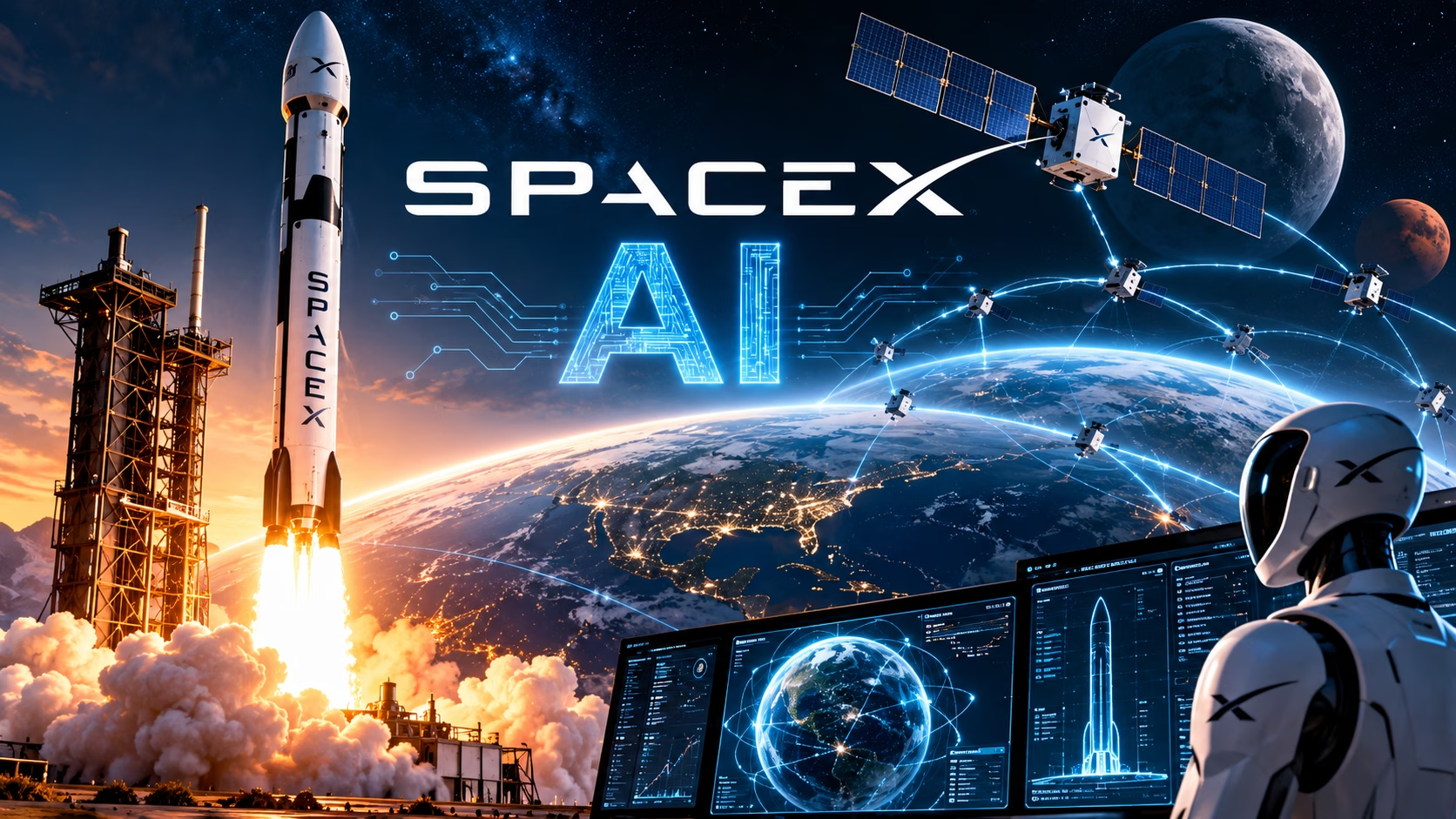
A reusable booster is falling back through the atmosphere at roughly 1,300 metres per second. Its flight computer has milliseconds to blend radar, GPS, inertial and barometric measurements, recompute a trajectory that satisfies structural limits, fuel margins and landing-site constraints, then command engine throttle and grid-fin deflection in a loop that never stops. It has no connection to a data centre and no human in the loop, just a small, radiation-aware, thermally stressed computer doing arithmetic that has to be right the first time.
Conversations about SpaceX AI tend to start here, and they often go wrong here too, because autonomous flight and a language model are different things. A landing burn is not a chatbot with thrusters. Keeping the two apart is a precondition for saying anything useful about what artificial intelligence can and cannot do inside a rocket company.
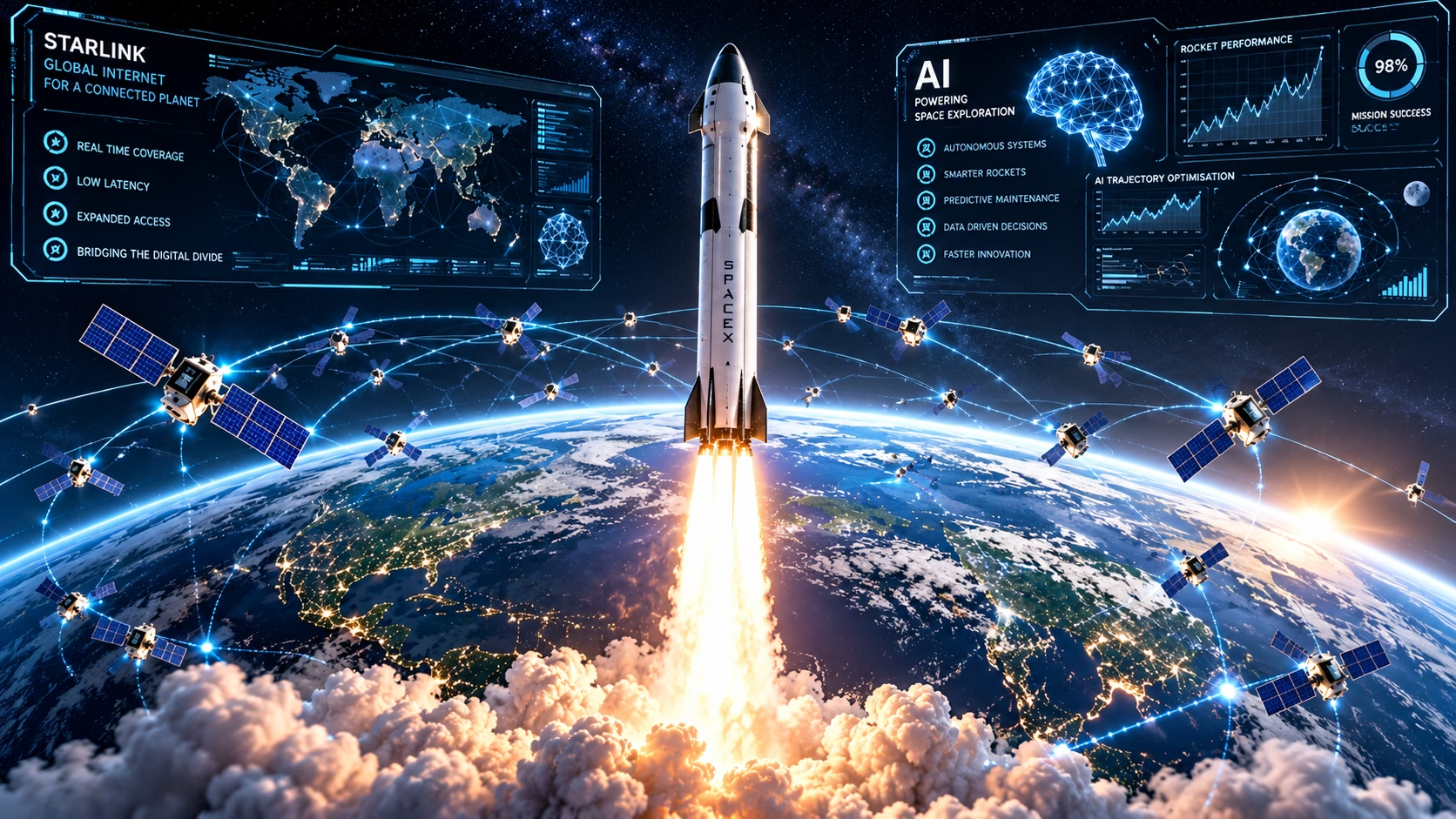
SpaceX does not publish a detailed account of its internal machine learning stack. It does not ship a branded AI product, and it has never claimed that a large language model flies a Falcon 9. What it does publish, in mission webcasts, FCC filings, NASA documentation, FAA licensing material and its own vehicle pages, shows a company that automates heavily, tests constantly and treats software as a primary flight system rather than a supporting utility.
This article covers what SpaceX AI plausibly means today, what it does not mean, and where machine learning earns its place in aerospace. It also looks at tools a developer can use to build aerospace-inspired systems, including the Best AI Tools for Developers in 2026, and at why the most impressive tool is rarely the one you want inside a control loop.
Where AI Fits in Modern Spaceflight
Four engineering realities explain why intelligent space systems need more than sophisticated algorithms.
Autonomy Is Not AI
A booster can land itself using deterministic guidance, navigation and control. No neural network is required, and none should be assumed without evidence.
ML Plays a Supporting Role
Its strongest near-term roles include simulation, anomaly detection, optimisation and off-line analysis, rather than unverified direct control of flight actuators.
Verification Is the Real Cost
Building a model is only the beginning. Proving reliable behaviour across the full operating envelope, including rare failures, is where aerospace validation becomes demanding.
Constraints Shape the Design
Radiation, thermal limits, intermittent links and tight power budgets influence where intelligence runs. These constraints often favour ground-based processing and carefully selected onboard edge functions.
What does SpaceX AI actually mean?
The phrase gets used for at least six different things, and mixing them up produces bad analysis. For background, see the broader complete guide to artificial intelligence on this site, which separates narrow task-specific systems from general-purpose models. Almost everything relevant to aerospace is narrow.
SpaceX AI, defined carefully
- Autonomous guidance and control. Flight software that plans, estimates and actuates without human input. Publicly documented as a capability on Falcon 9, Dragon and Starship, though the internal algorithms are not disclosed.
- Machine learning in aerospace engineering. Models used off-line or in ground systems for prediction, optimisation, anomaly detection and design exploration. Widely used across the industry; SpaceX has advertised engineering roles touching on these areas but publishes few specifics.
- Intelligent satellite network management. Automated scheduling, routing, interference handling and collision avoidance across a large constellation. Starlink is heavily automated and has documented autonomous collision avoidance behaviour, but the internal control architecture is proprietary.
- Computer vision and robotics. Sensor-driven inspection, docking and manufacturing automation. Dragon’s autonomous docking uses sensor fusion and flight software rather than consumer-grade vision models.
- Simulation and predictive maintenance. Digital twins, hardware-in-the-loop test benches and telemetry-driven health monitoring. Strongly implied by the pace of flight testing, but not published in detail.
- Generative AI in engineering workflows. Coding assistants, documentation tools and log analysis. Plausible and increasingly common across the industry, but there is no credible public evidence that SpaceX uses any specific generative model.
It is tempting to assume that a company famous for rapid iteration must be wiring large language models into everything. There is no public evidence for that, and there are good engineering reasons for caution: a generative model that sometimes gives a plausible but wrong answer is a poor fit for a system that has to be correct on every attempt, with no retry.
Technical note. A rocket can be fully autonomous and contain no machine learning at all. Guidance, navigation and control (GNC) systems typically combine state estimation, trajectory optimisation and feedback control, all implemented as deterministic, extensively validated code. Machine learning can complement these systems. It is not synonymous with them.
Where the evidence actually sits
Publicly confirmed facts are narrower than the popular narrative. Falcon 9 boosters land autonomously on drone ships and landing zones, a capability SpaceX has demonstrated hundreds of times and documents on its vehicle pages. Dragon spacecraft perform autonomous docking with the International Space Station using an approach monitored by crews but executed by flight software. Starlink satellites perform automated collision avoidance manoeuvres, and SpaceX has reported large numbers of these in regulatory filings. Starship vehicles carry autonomous flight safety systems that can terminate a flight without a human decision, as required by modern launch licensing frameworks.
What is not public is the internal architecture behind any of this. There is no published description of a neural network inside the Falcon 9 landing loop, no benchmark of a SpaceX anomaly detector, and no source repository. Any article that presents such specifics is inventing them. SpaceX clearly automates deeply, and machine learning is likely present in engineering support functions, but the boundary between the two is not documented.
Where AI Could Make a Difference in SpaceX
From reusable rockets to satellite safety, explore the potential applications, available evidence and engineering challenges behind intelligent space systems.
Autonomous Booster Landing
Reusable launch vehicles, reduced recovery costs and precise landing operations.
Guidance, navigation and control (GNC) can perform the landing deterministically. Autonomous operation alone does not establish that machine learning is involved.
Autonomous Dragon Docking
Reduced crew workload, repeatable rendezvous and precise spacecraft approach operations.
Sensor faults, navigation uncertainty and unexpected conditions require rigorous fault handling and safe fallback procedures.
Starlink Collision Avoidance
Managing collision risks across a large satellite constellation operating in crowded orbital regions.
Coordination with other satellite operators, changing orbital data and inconsistent tracking information remain difficult. Internal decision logic is not fully public.
Telemetry Anomaly Detection
Spotting unusual sensor readings or system behaviour before a small issue develops into a larger fault.
SpaceX-specific implementations are not established here. False positives can overwhelm operators, while missed anomalies can delay fault discovery.
Predictive Maintenance
Identifying degradation earlier, planning maintenance and potentially reducing unplanned downtime.
Reliable predictions need representative operational data, validated models and enough labelled failure examples. SpaceX-specific deployment is not confirmed here.
Trajectory Optimisation
Finding efficient flight paths, managing fuel use and evaluating a wider range of mission scenarios.
Any proposed trajectory must satisfy physical, operational and safety constraints. Optimisation results need independent validation before use.
Onboard Vision for Inspection
Assessing images for possible damage, surface changes or inspection targets with less reliance on ground review.
Limited power and memory, radiation exposure and difficult lighting conditions constrain onboard vision. SpaceX deployment is not confirmed here.
Generative AI for Engineering
Helping engineers draft documentation, explore design alternatives and analyse technical information more quickly.
Hallucinations, incorrect calculations and untraceable claims make independent review essential for safety-critical engineering. SpaceX-specific adoption is not established here.
How SpaceX’s engineering environment creates opportunities for AI
Aerospace is an unusual software environment. Most web engineers work with round-trip latencies measured in tens of milliseconds, near-unlimited memory and the ability to push a fix within minutes. Flight software has none of those luxuries. A typical onboard computer runs a real-time operating system with hard deadlines, a few hundred megabytes of memory, a power budget measured in watts and a communication link that may vanish for minutes at a time.
Those constraints shape where intelligence can live. They also explain why the aerospace industry has spent decades on deterministic, verifiable software rather than reaching for the largest model available.
Flight dynamics and trajectory planning
Trajectory problems are optimisation problems with hard constraints: structural load limits, engine throttle ranges, propellant margins, aerodynamic heating, range safety boundaries and, for landing, a precise target state at engine cutoff. Classical approaches use convex optimisation, sequential quadratic programming and direct collocation. These methods produce solutions with provable properties, which matters when a human life is downstream of the answer.
Machine learning enters this space in a supporting role. A learned surrogate model can approximate an expensive physics simulation and speed up design-space exploration by orders of magnitude. Reinforcement learning can discover non-obvious control policies in simulation, which engineers then analyse, simplify and translate into something verifiable. The output of that process is not a neural network bolted to a rocket. It is a human-understandable control law informed by what the search found.
Sensor fusion and state estimation
No single sensor is trustworthy in flight. GPS can be degraded or denied. Radar can return clutter. Inertial measurement units drift. Barometric readings are affected by weather and vehicle aerodynamics. The standard solution is a filter, typically an extended or unscented Kalman filter, that fuses measurements with a physical model of the vehicle and produces a best estimate of position, velocity and attitude, plus a covariance describing confidence.
This is statistical estimation, not deep learning, though the two are not mutually exclusive. Learned models can help characterise sensor noise, detect when a sensor has failed, or adapt to changing aerodynamic conditions. The core filter, however, usually remains a model-based estimator because its failure modes are understood and can be bounded.
Fault detection and telemetry analysis
This is where machine learning has the clearest near-term value. A launch produces thousands of channels sampled at high rates: pressures, temperatures, turbopump speeds, vibration spectra, valve positions, electrical currents. Finding the early signature of an incipient failure inside that torrent is a genuine data problem, and it is one where statistical and learned models have a real advantage over fixed thresholds.
To understand why, it helps to know what machine learning actually does: it fits a function to data rather than requiring a human to specify the rule. That is powerful when the rule is unknown, and dangerous when the data does not cover the failure you eventually encounter.
Hardware and real-time constraints
Onboard compute is deliberately conservative. Radiation-tolerant processors lag consumer hardware by years, and for good reason: a bit flip in a control loop is not a recoverable error. Software is often written in C or Ada, compiled with restricted language subsets, and verified against standards such as DO-178C for airborne systems or equivalent internal processes for launch vehicles. Adding a learned component to that stack means adding a new class of evidence requirement, and the cost of generating that evidence frequently outweighs the benefit.
Developer takeaway. The most useful question in this domain is not “can a model do this?” but “can I prove the model does this correctly across every condition the vehicle will meet, including the ones I have never seen?” If the answer is no, the model belongs in a ground tool or a monitoring role, not in the actuator path.
Rocket reusability, autonomous landing and intelligent control
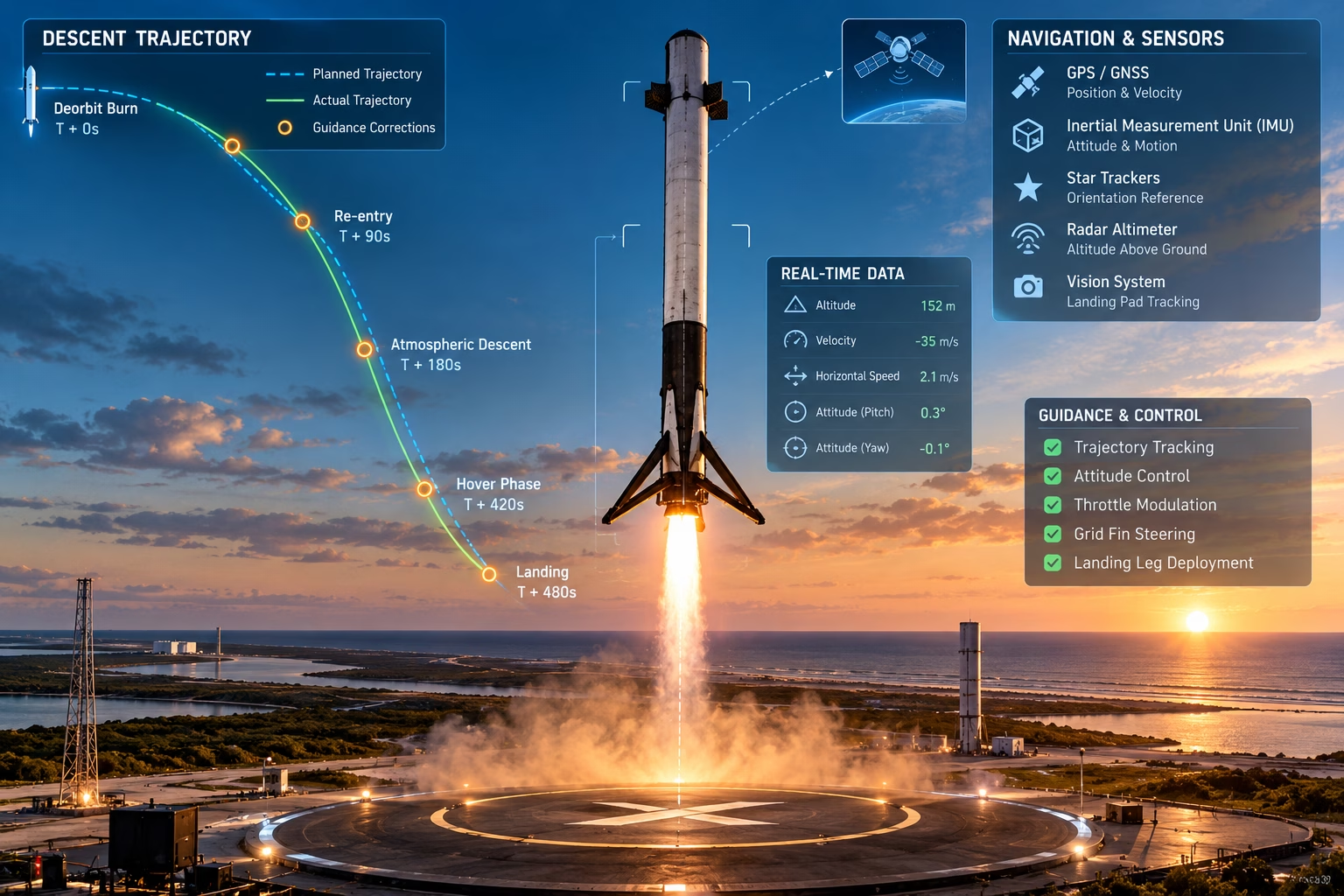
A Falcon 9 landing is a good case for seeing which parts of an automated system are “intelligent” and which are simply well-designed control.
The sequence, in plain language
After stage separation, the booster continues on a ballistic arc. A boostback burn, when used, reverses horizontal velocity and shapes the impact point. During coast, cold gas thrusters orient the vehicle. The re-entry burn slows the vehicle before the densest part of the atmosphere, limiting heating and structural loads. Grid fins then steer the vehicle through the aerodynamic regime, acting as control surfaces with authority that changes dramatically with speed and altitude. Finally, a landing burn brings velocity to near zero at the target altitude, with a single engine throttled to a precise thrust level.
At every stage, the flight computer is solving a constrained problem: where am I, where do I need to be, what is the set of achievable trajectories given remaining propellant, and which control action keeps me inside the safe envelope? The solutions come from numerical optimisation and feedback control, not from a model that has learned what landings look like.
Inside the Rocket Control Loop
How sensor data can flow through estimation, guidance and control to influence a rocket’s motion.
Sensors
IMU, GPS, radar, barometer and pressure transducers collect measurements about the vehicle and its environment.
State Estimation
Sensor fusion estimates position, velocity and attitude, alongside uncertainty such as covariance.
Guidance
Determines the target state and a feasible trajectory within mission and vehicle constraints.
Control
Calculates commands for throttle, engine gimbal, grid fins or cold-gas systems, where fitted.
Actuators
Engines and aerodynamic or attitude-control surfaces respond to commands and change vehicle motion.
Fault Detection
Monitors inconsistent readings, sensor faults and unexpected system behaviour alongside the control loop.
Engineering Oversight
Testing, safety analysis, validation and human engineering decisions support the wider system.
Technical note: This is a conceptual aerospace control architecture showing a general engineering pattern. It is not a verified representation of SpaceX’s internal software, sensor suite or control-system implementation. Actual systems vary by vehicle and mission.
Where machine learning could help
Three areas stand out, and all of them sit outside the fast inner loop.
Simulation fidelity. Landing simulations must model aerodynamics, engine transients, slosh dynamics and structural flexibility. Learned models can approximate some of these effects faster than high-fidelity physics, letting engineers run thousands of Monte Carlo trials overnight instead of dozens. The model never flies; it just makes the test campaign cheaper.
Anomaly detection on the ground. Between flights, terabytes of telemetry accumulate. Learned detectors can surface subtle correlations that fixed thresholds miss, giving engineers a shorter list of things to investigate. This is the classic human-in-the-loop pattern: the model proposes, the engineer disposes.
Design optimisation. Surrogate models can guide the search for better engine parameters, fin shapes or structural layouts. Again, the output is a design decision reviewed by humans, not a runtime control signal.
Why the inner loop stays conventional
The reason is certification. A learned controller has no closed-form guarantee of stability, no straightforward way to prove that it will never command an out-of-envelope actuator position, and no clean story for what happens when it encounters an input distribution it has never seen. Classical control offers Lyapunov stability proofs, gain and phase margins, and well-understood failure behaviour. Those properties are worth more than a few percent of efficiency.
There is active research into formally verified neural controllers, and some results are genuinely promising. But research promise and flight qualification are separated by years of test campaigns, and no public evidence suggests SpaceX has crossed that gap for primary flight control.
Starlink AI and the challenge of managing a satellite network
Starlink is arguably the largest distributed system SpaceX operates, and it is the place where “SpaceX AI” has the most plausible operational meaning, even though the specifics remain private. Several thousand satellites, tens of thousands of user terminals, a global ground segment and a laser inter-satellite mesh add up to a scheduling problem that no human team could manage by hand.
The coordination problem
Every satellite must know which ground station to talk to, which user terminals to serve, which frequencies to use and when to hand over as orbital geometry shifts. Interference between adjacent beams must be managed. Capacity must be routed to where demand actually is, which changes by the hour as populations wake up, commute and go to bed. Meanwhile, each satellite is moving at roughly 7.5 kilometres per second, so the topology changes constantly.
Classical operations research handles much of this: linear programming for resource allocation, graph algorithms for routing, constraint solvers for scheduling. Machine learning adds value where the problem is too complex for an exact solver, or where demand must be forecast rather than optimised against known values.
Traffic prediction and resource allocation
Predicting demand is a time-series problem with strong seasonality, spatial structure and occasional shocks. Gradient-boosted trees and sequence models are both reasonable choices, and the aerospace industry has substantial experience with both. The output feeds a scheduler that decides where capacity goes. The model is advisory; the scheduler remains a conventional optimiser with hard constraints.
This is a recurring pattern in large-scale infrastructure. The learned component forecasts, the deterministic component decides. Keeping them separate makes the system debuggable and keeps a bad forecast from becoming an unsafe command.
Collision avoidance and space safety
Low Earth orbit is increasingly crowded, and conjunction assessment is a serious operational burden. SpaceX has reported performing tens of thousands of avoidance manoeuvres over six-month periods in filings to regulators, a scale that only automation makes feasible. The logic that decides when and how much to manoeuvre is not public, but it must combine conjunction screening, propellant budgeting, service continuity and coordination with other operators.
Whether any part of that pipeline uses machine learning is unknown. What is certain is that the pipeline must be deterministic enough to audit after the fact, because regulators and other operators will ask why a specific satellite moved at a specific time.
What we can and cannot say. Starlink operations are heavily automated and operate at a scale that requires algorithmic management. The specific algorithms, including whether any use learned models, are proprietary and undocumented in public sources. Treat confident claims to the contrary with suspicion.
Machine learning, computer vision and space robotics
Computer vision in space differs from computer vision on Earth in ways that matter to anyone building models for constrained hardware.
What vision can do in orbit
Docking, proximity operations, inspection, debris characterisation and surface navigation all benefit from image understanding. NASA’s terrain relative navigation work for Mars landing demonstrated that onboard vision could match real-time camera images against an onboard map and update the descent trajectory, a technique that materially improved landing accuracy. Similar ideas apply to satellite servicing and to autonomous inspection of a spacecraft’s own exterior.
Robotic inspection is an especially practical case. A camera and a learned detector can flag thermal blanket damage, micrometeoroid impacts or unexpected ice formation, tasks that currently require crew time or expensive downlink bandwidth. The model runs on an edge processor and sends a short summary rather than raw frames, which matters when your data link is a few hundred kilobits per second.
The constraint stack
An Earth-based vision model might run on a GPU with 24 gigabytes of memory and unlimited power. A spacecraft processor may have a few hundred milliWatts of compute budget, a radiation environment that causes single-event upsets, and no ability to download a patch if something goes wrong. That changes the design in concrete ways:
Teams quantise and prune models aggressively, choose architectures for predictable memory use rather than peak accuracy, and schedule inference around thermal and power cycles. They validate outputs against physically plausible ranges before anything downstream consumes them, and they test every model against corrupted, saturated and out-of-distribution images, because in space the camera will eventually point at the sun.
A model trained on clean laboratory images may also fail on orbit, where lighting is harsh, contrast is extreme and the background is a black void that confuses texture-based features. Domain shift is the default condition there, not a theoretical concern.
Can generative AI help build better aerospace software?
This is the question developers care about most. The answer is yes, in specific and bounded ways, as long as you treat the output as a draft rather than a deliverable.
Where it genuinely helps
Generative tools are good at the parts of engineering that are tedious rather than difficult. Explaining an unfamiliar codebase is a strong use case: pointing a model at a legacy telemetry parser and asking it to describe the data flow often saves an afternoon. Generating test scaffolding from a function signature is another. Producing simulation scripts that sweep a parameter range, or converting a MATLAB prototype into Python for a quick check, are tasks where a plausible first draft is genuinely valuable.
Log analysis is another good fit. Flight and test logs are verbose, semi-structured and repetitive. A model that can summarise anomalies across ten thousand lines, or cluster error messages by likely root cause, gives an engineer a better starting point than scrolling.
Our own analysis of GPT-6 Astra looked at how far these capabilities have moved. Models are getting better at reasoning across long technical contexts, which helps with codebase comprehension. It does not make them trustworthy for computing a re-entry trajectory.
Where it fails, sometimes quietly
The failure modes are familiar, but the stakes are higher in aerospace.
Hallucinated APIs. A model that invents a function name is annoying in a web app and unacceptable in flight software. The compiler will catch it, but only if the code is compiled, which means it must first survive review.
Incorrect numerical reasoning. Language models are not calculators. A generated unit conversion or a sign error in a coordinate transform can produce code that runs perfectly and is wrong by a factor of ten.
Insecure or unsafe patterns. Generated code often omits bounds checks, ignores integer overflow and assumes inputs are well-formed. In a system parsing sensor data, those omissions are exactly the ones that matter.
Hidden assumptions. A model may confidently produce a Kalman filter that assumes linear dynamics, which is fine for some problems and wrong for others. The assumption is buried in the maths, not flagged in a comment.
Insufficient test coverage. Generated tests tend to test the happy path. Edge cases are the ones that find bugs, and edge cases are exactly what a model trained on typical code will underweight.
Rule of thumb. Use generative AI to reduce the cost of the first draft, never to reduce the cost of verification. In safety-critical work, verification is the product. Anything that makes it cheaper without making it more thorough is a net loss.
Best AI Tools for Developers in 2026: lessons for space and aerospace projects
Anyone comparing the Best AI Tools for Developers in 2026 for aerospace-style work quickly notices that the market splits into layers. There are assistants that write code, platforms that run experiments, tools that verify behaviour and tools that document what happened. Choosing well means matching the layer to the task, not picking the assistant with the loudest marketing.
None of the tools below are endorsed by SpaceX, and there is no public evidence that SpaceX uses any particular one. They are examples that independent developers and engineering teams can evaluate for themselves. Our guide to the Best AI Tools for Developers in 2026 covers the wider landscape in full, and this section builds on it rather than replacing it.
Choosing among the tools
These tools fall into roughly six functional groups, and the groups carry very different risks. Code assistants sit in the editor and suggest completions or whole functions. Agentic coding tools take a task description and edit multiple files. Experiment trackers record what you ran and what happened. Data and ML frameworks provide the actual modelling primitives. Verification tools check that the code does what you claim. Documentation generators turn code and logs into readable artefacts.
It also helps to sort them by what they are allowed to touch. A tool that suggests a completion inside a test file is low risk. A tool that rewrites a flight-software module and commits automatically is high risk regardless of how good its benchmark scores look.
AI Coding, Simulation & Verification Tools
A practical overview of tools that may support aerospace software development, telemetry analysis, simulation and verification. Each tool has a different role, and none replaces engineering review or safety assurance.
01 / AI Coding Assistants
GitHub Copilot
IDE ASSISTANTMain purpose: In-editor code completion and chat.
Aerospace use: Boilerplate, test scaffolding and explaining unfamiliar modules.
Strength: Broad language support and tight IDE integration.
Limitation: Suggestions can be subtly wrong; context is limited.
Cursor
AI-FIRST EDITORMain purpose: AI-first code editing and multi-file changes.
Aerospace use: Refactoring ground tools and navigating large repositories.
Strength: Fast iteration with repository context.
Limitation: Agentic edits can spread across many files.
Claude Code
TERMINAL AGENTMain purpose: Terminal-based agentic coding assistance.
Aerospace use: Scripted refactors, test generation and log triage.
Strength: Works with existing tools and longer tasks.
Limitation: Poorly scoped tasks can trigger excessive edits.
JetBrains AI Assistant
IDE ASSISTANTMain purpose: Assistance integrated into JetBrains IDEs.
Aerospace use: Code explanation, documentation and test drafts.
Strength: IDE awareness, including Java and Kotlin workflows.
Limitation: Quality varies by language and IDE version.
Amazon Q Developer
CLOUD DEVELOPMENTMain purpose: Developer assistance with AWS-oriented workflows.
Aerospace use: Cloud telemetry pipelines and infrastructure code.
Strength: Helpful for AWS development patterns.
Limitation: Less focused on embedded systems development.
Gemini Code Assist
AI CODINGMain purpose: IDE coding assistance with Google Cloud integration.
Aerospace use: Data-analysis scripts and notebook exploration.
Strength: Useful in analytics-heavy workflows.
Limitation: Suitability for low-level systems code needs evaluation.
Tabnine
CODE COMPLETIONMain purpose: Code completion with privacy-focused deployment options.
Aerospace use: Development environments with strict data controls.
Strength: Enterprise controls and deployment choices.
Limitation: Model quality and features vary by configuration.
Continue
OPEN-SOURCE FRAMEWORKMain purpose: Configurable AI coding assistant framework.
Aerospace use: Connecting internal models and engineering documentation.
Strength: Flexible and vendor-neutral architecture.
Limitation: Requires engineering effort to configure and maintain.
Aider
CLI PAIR PROGRAMMINGMain purpose: Command-line pair programming with Git integration.
Aerospace use: Scripted repository edits and local-model workflows.
Strength: Transparent diffs and version-control workflow.
Limitation: Terminal-based interaction may not suit every developer.
Qodo
TESTING & CODE REVIEWMain purpose: AI-assisted testing and code review.
Aerospace use: Exploring test gaps in simulation and parsing code.
Strength: Focus on test quality and review workflows.
Limitation: Generated tests can miss important failure modes.
02 / Machine Learning & Experiment Management
MLflow
EXPERIMENT TRACKINGMain purpose: Experiment tracking and model registry.
Aerospace use: Reproducible anomaly-detection experiments.
Strength: Open-source tooling and experiment metadata.
Limitation: Results are only as consistent as the team’s workflow.
Weights & Biases
ML VISUALISATIONMain purpose: Experiment tracking, dashboards and collaboration.
Aerospace use: Comparing detectors across telemetry datasets.
Strength: Rich visualisation and team workflows.
Limitation: Hosted services can introduce data-handling concerns.
DVC
DATA VERSION CONTROLMain purpose: Versioning datasets and ML pipeline assets.
Aerospace use: Tracking large telemetry and simulation datasets.
Strength: Git-oriented workflow and flexible storage.
Limitation: Adds operational overhead.
scikit-learn
CLASSICAL MACHINE LEARNINGMain purpose: Classical ML algorithms and feature pipelines.
Aerospace use: Baseline anomaly detectors and telemetry features.
Strength: Mature documentation and interpretable baselines.
Limitation: Not designed for every deep-learning workload.
PyTorch
DEEP LEARNINGMain purpose: Deep-learning research and model development.
Aerospace use: Sequence models, computer vision and prototypes.
Strength: Flexible framework and extensive ecosystem.
Limitation: Constrained-hardware deployment needs additional work.
Optuna
HYPERPARAMETER SEARCHMain purpose: Hyperparameter optimisation and search.
Aerospace use: Tuning detectors and simulation surrogates.
Strength: Efficient search with pruning support.
Limitation: Poor validation design can cause overfitting.
03 / Testing, Code Quality & Engineering Verification
pytest
AUTOMATED TESTINGMain purpose: Python testing framework.
Aerospace use: Property tests for parsers and estimators.
Strength: Simple, extensible and widely understood.
Limitation: Does not replace formal verification.
SonarQube
STATIC ANALYSISMain purpose: Static analysis and code-quality gates.
Aerospace use: Enforcing coding standards across repositories.
Strength: Broad language support and CI integration.
Limitation: Rule configuration is needed to manage noise.
Polyspace
STATIC CODE VERIFICATIONMain purpose: Static analysis and verification for C and C++.
Aerospace use: Checking selected runtime errors and coding defects.
Strength: Can provide strong evidence for specific code properties.
Limitation: Commercial tooling and specialist configuration may be required.
Simulink
MODEL-BASED DESIGNMain purpose: Model-based design, simulation and control-system workflows.
Aerospace use: Control-law prototyping and test-harness development.
Strength: Visual modelling and established engineering workflows.
Limitation: Commercial licensing and toolchain dependencies.
The distinction that matters most is between tools for exploring and tools for certifying. A coding assistant is excellent for trying an idea at 2 a.m. on a weekend, and a poor choice for producing the artefact a safety reviewer will examine. Almost without exception, the Best AI Tools for Developers in 2026 are exploration tools. They shorten the path from idea to working prototype but not the path from prototype to proven system, and a vendor who claims otherwise is overselling.
Where the Engineering Effort Goes
AI can speed up selected development tasks, but testing, verification and engineering evidence remain essential in safety-critical projects.
Important: This is an illustrative workflow model, not measured SpaceX performance. The scores represent hypothetical relative effort in an AI-assisted aerospace project, not actual percentages, engineering hours or verified industry statistics.
How to read this chart: Drafting and prototyping may benefit from AI assistance, while verification and evidence generation still require careful judgement, testing and documented engineering review.
Building a small SpaceX-inspired AI project
A good first project is a synthetic telemetry anomaly detector. It has a clear objective and measurable results, and it teaches a central aerospace lesson: telling a model that looks good from one that is useful.
The problem
You have a stream of sensor readings from a simulated engine or tank. Most samples are nominal with Gaussian noise. A small number belong to an injected fault, such as a slow drift or a brief pressure spike. Your job is to flag unusual readings without drowning the operator in false alarms.
Sample data and environment
Generate the data yourself so you know the ground truth. Any Python 3 environment works; only the standard library is needed for the core example. If you want to extend it, pandas, NumPy and scikit-learn are reasonable additions, all available under permissive licences.
Baseline algorithm
Start with a rolling mean and standard deviation. Compute a z-score for each new sample relative to the previous window, and flag it when the absolute z-score exceeds a threshold. This is a statistical detector, not machine learning, and that is deliberate: you need a baseline to beat before a learned model means anything.
Where machine learning might help
Once the baseline works, try an isolation forest, a one-class support vector machine or a small autoencoder trained on nominal data only. Compare all of them against the same ground truth. If the learned model does not clearly beat the rolling z-score, you have learned that the problem is easy and the extra complexity is not justified, which is worth more than a working model.
Evaluation, false positives and false negatives
Track true positives, false positives and false negatives separately. In aerospace, a false positive means an operator investigates something that is fine, which wastes time and erodes trust. A false negative means a real fault is missed, which can be catastrophic. These costs are not symmetric, and the threshold should be set with that asymmetry in mind.
Keep the test set separate from the development set, and make sure the test set contains fault types the model has never seen. A detector that only recognises the exact fault it was trained on is a lookup table with extra steps.
Safety boundary. This project must remain a simulation. Never connect a hobby model to real hardware, and never treat a toy detector as flight-ready software. The purpose is to learn the workflow, not to control a vehicle.
"""
Synthetic telemetry anomaly detector.

Teaching example only. This is not flight software, it does not connect
to any real vehicle, and it is not a reconstruction of any SpaceX system.
Only the Python standard library is required.
"""

import random
from collections import deque

random.seed(7)


def generate_telemetry(samples=240, nominal=100.0, noise=0.6):
    """Create a synthetic sensor series with two injected fault windows."""
    series = []
    for i in range(samples):
        bias = 0.0
        if 90 <= i < 105:
            bias = 7.0        # slow drift, the kind a threshold might miss
        if 170 <= i < 176:
            bias = -4.5       # brief spike, the kind a threshold will catch
        series.append(nominal + bias + random.gauss(0.0, noise))
    return series


def rolling_detector(series, window=12, z_threshold=3.0):
    """Flag samples whose z-score against a trailing window is too large."""
    window_values = deque(maxlen=window)
    flags = []

    for value in series:
        if len(window_values) < window:
            window_values.append(value)
            flags.append(False)
            continue

        mean = sum(window_values) / len(window_values)
        variance = sum((x - mean) ** 2 for x in window_values) / len(window_values)
        std = variance ** 0.5

        if std < 1e-6:
            flags.append(False)
        else:
            z = (value - mean) / std
            flags.append(abs(z) > z_threshold)

        window_values.append(value)

    return flags


def evaluate(flags, truth):
    """Count true positives, false positives and false negatives."""
    tp = sum(1 for f, t in zip(flags, truth) if f and t)
    fp = sum(1 for f, t in zip(flags, truth) if f and not t)
    fn = sum(1 for f, t in zip(flags, truth) if not f and t)
    return tp, fp, fn


series = generate_telemetry()
truth = [(90 <= i < 105) or (170 <= i < 176) for i in range(len(series))]
flags = rolling_detector(series)
tp, fp, fn = evaluate(flags, truth)

print(f"Samples flagged: {sum(flags)}")
print(f"True positives: {tp}, false positives: {fp}, false negatives: {fn}")
Run it, then change the noise level, the window size and the threshold. You will find that the drift window is the hard case: a slow bias moves the rolling mean along with it, so the z-score stays low. That is exactly the kind of subtle failure that motivates more sophisticated detectors, and it is why the baseline matters. It tells you where the simple approach stops working.
If you want to go further, several of the experiment trackers among the Best AI Tools for Developers in 2026 make it easy to compare variants systematically rather than by memory. That habit is worth more than any particular algorithm.
A technical comparison of AI, automation and classical control
The most common mistake in discussions of SpaceX AI is treating every automated behaviour as artificial intelligence and every AI system as interchangeable with control software. The table below separates the categories.
| Approach | Strengths | Typical use cases | Interpretability | Compute requirements | Safety considerations |
|---|---|---|---|---|---|
| Classical control | Stability proofs, bounded behaviour, well-understood margins | Attitude control, engine gimbal, landing burn | High, mathematics is explicit | Very low, deterministic timing | Mature verification methods exist |
| Rule-based automation | Predictable, auditable, easy to reason about | Fault response trees, sequence logic, AFTS rules | High, rules are readable | Very low | Rule coverage must be demonstrated |
| Statistical machine learning | Finds patterns humans miss, fast inference | Anomaly detection, demand forecasting, surrogate models | Medium, depends on model class | Moderate for training, low for inference | Distribution shift is the main risk |
| Deep learning | Strong on perception and high-dimensional data | Vision, sequence modelling, complex sensor fusion | Low without extra tooling | High for training, moderate to high for inference | Needs adversarial and out-of-distribution testing |
| Generative AI | Fluent at code, text and reasoning over context | Drafting code, documentation, log summarisation | Low, outputs are not reproducible by default | High, usually off-board | Hallucination and silent error risk |
The table points to one conclusion. The best architecture is not the one with the largest model but the one that puts each component where its properties are an asset: a stability proof in the control loop, a pattern recogniser in the monitoring layer, and a language model on a developer’s laptop, well away from the actuator path.
SpaceX AI architecture: a conceptual engineering diagram
The diagram below is a hypothetical architecture for an AI-assisted aerospace system. It is a teaching device, not a description of any internal SpaceX design, and it deliberately places learned components where they can be checked.
From Sensor Data to Validated Decisions
A conceptual view of how aerospace data can move through processing, estimation and decision support, with independent monitoring and verification surrounding the main flow.
Telemetry and Sensors
High-rate channels and raw measurements collected from relevant vehicle systems.
Data Processing
Cleaning, calibration, time alignment and checks for missing or inconsistent data.
State Estimation
Filtered state estimates with uncertainty information to support downstream decisions.
Decision or Optimisation
Planners, monitors and advisory models evaluate options within defined constraints.
Validated Control Logic
Deterministic, bounded and tested logic governs any authorised control outputs.
Independent Oversight and Verification
Fault Detection
Checks for abnormal behaviour, inconsistent measurements and violated operating limits. Depending on system design, it may raise an alert or inhibit an action.
Simulation and Verification
Tests models and candidate designs against scenarios, edge cases and requirements. The exact relationship with the operational system depends on the workflow.
Engineering Oversight
Engineers review evidence, approve changes, investigate anomalies and make decisions under the applicable safety process.
Monitoring can observe multiple stages and trigger alerts or protective responses when configured to do so. Its authority to veto or interrupt an action depends on the actual system architecture and safety design.
Conceptual illustration only: This diagram shows a general aerospace engineering pattern, not SpaceX’s internal architecture. Data may flow left to right under strict latency constraints, while monitoring, simulation, verification and human oversight support the development and operational process. Their precise timing and authority vary by system.
Three properties of this diagram matter. First, the fast path is short: sensors to actuators with a small number of deterministic stages, because latency is a physical constraint. Second, the learned or advisory components sit in the decision and monitoring layers, where their outputs can be checked against physical limits before anything moves. Third, verification is drawn as a peer of the runtime path rather than a phase that happens once, because in aerospace the tests keep running for the life of the vehicle.
Fail-safe behaviour is also architectural. When a component’s output fails a plausibility check, the system should degrade to a known-safe mode rather than propagating the value. That requires every stage to have a defined behaviour under invalid input, which is a design discipline rather than a model property.
Benefits, limitations and engineering trade-offs
A list of AI benefits is easy to write. A more useful one says why each benefit might not materialise.
Where the benefits are real
Anomaly detection at scale. Human analysts cannot watch thousands of channels simultaneously. Statistical and learned detectors can, and they can surface candidates for human review. The benefit is real as long as the false positive rate is low enough that reviewers do not start ignoring the alerts.
Faster analysis cycles. Simulation surrogates and automated log triage genuinely compress the time between a test flight and a useful conclusion. In an iterative development programme, that compression compounds.
Better design-space exploration. Optimisation and learned surrogates let engineers evaluate more candidates than manual iteration allows. The output is a better-informed human decision, not an autonomous one.
Operational planning. Forecasting demand, scheduling maintenance and allocating resources are problems where machine learning has a long track record in other industries and transfers reasonably well.
Where the limits bite
Training data gaps. Failures are rare by design. A model trained on ten nominal flights and one failure has almost no information about the failure class. This is the fundamental obstacle to learned fault prediction in aerospace.
Model drift. A detector calibrated on one vehicle configuration may misbehave on the next. Every hardware change is a potential distribution shift.
Sensor failure. Models consume sensor data and inherit its problems. A stuck sensor or a calibration error can produce confident nonsense.
Adversarial and unusual inputs. Not every anomaly is malicious, but unusual inputs are exactly where learned models are least reliable, and exactly where they are most needed.
Latency and compute limits. The onboard budget is small. Anything that requires a data centre is a ground tool by definition.
Explainability and verification cost. A model that cannot explain itself is expensive to certify. The verification cost frequently exceeds the performance benefit.
Consequences of error. In a web application, a bad prediction costs a page view. In a launch vehicle, it can cost a vehicle. The asymmetry justifies a much higher bar.
AI is not useless in aerospace. It is useful when it solves a defined problem and can be tested against meaningful criteria, which is a stricter standard than most software domains apply, and the right one.
What developers can learn from the SpaceX AI problem-solving mindset
This section does not attribute specific internal practices to SpaceX, because there is no documentation for them. What follows are general engineering lessons that aerospace makes vivid and that transfer to any system that must not fail.
Start from a measurable objective. “Improve reliability” is not an objective. “Reduce false negatives on this fault class below this rate without exceeding this false positive budget” is. Aerospace engineers are forced to be precise because the test campaign has to end at some point, and precision is what makes that possible.
Think at the system level. A model is one component in a chain that includes sensors, power, thermal management, communications and humans. Optimising the model in isolation frequently makes the system worse.
Simulate before you build. Simulation is cheap and hardware is expensive. The discipline of running thousands of scenarios before touching metal is directly applicable to any software system with meaningful failure modes.
Automate the tests, not the judgement. Automated testing is essential. Automated approval is not. The distinction is easy to blur when tooling is good, and blurring it causes accidents.
Build observability in from the start. When something goes wrong at 40 kilometres altitude, the only evidence is the telemetry you chose to record. Systems that cannot explain their own behaviour after the fact are systems you cannot improve.
Design for fault tolerance, not fault avoidance. Components fail. The question is what the system does next. A well-designed chain degrades gracefully; a poorly designed one fails completely because no one planned for a sensor returning NaN.
Insist on reproducibility. If you cannot rerun the experiment that produced a result, you do not have a result. Version your data, your code and your environment.
Validate incrementally. Big-bang verification is where schedules die. Small, frequent, evidence-generating checks catch problems while they are still cheap.
The future of SpaceX AI and intelligent space infrastructure
Predicting specific SpaceX products is a losing game, and no responsible analysis should claim to know what the company will announce. The most that can be said is which way the technology is moving and what looks plausible over what timescales.
Near-term, realistic
Onboard anomaly detection will improve as radiation-tolerant processors get more capable. Ground-side analysis will become more automated, with learned models triaging telemetry before humans see it. Simulation will get faster and more accurate, shortening design cycles. Satellite operations will become more autonomous because the constellation size makes any other approach infeasible. Digital twins, already used across aerospace, will become standard for launch vehicle health monitoring.
None of this requires a breakthrough. It is the steady application of existing methods to a domain with clear economic incentives.
Medium-term, plausible
Robotic servicing and inspection become more autonomous, with vision models operating on constrained hardware. Launch and re-entry become more automated, with human oversight shifting from control to supervision. Space-based computing grows as a category, which raises the question of where inference should happen when the data is generated in orbit.
Formally verified neural controllers may begin to appear in narrow, well-bounded roles. The research is progressing, and the payoff for specific problems, such as learned perception inside a proven safety envelope, is real. Whether that reaches primary flight control in the next decade is genuinely uncertain.
Longer-term, speculative
Fully autonomous spacecraft that plan their own missions, repair themselves and coordinate without ground intervention are a legitimate research direction and a very long way from operational reality. The obstacles are mainly verification and liability, plus the fact that a system which cannot explain its decisions cannot be trusted with expensive hardware.
Dependable software, robust control systems and reliable data pipelines stay essential as models improve. A better predictor does not remove the need for a stable estimator, and a smarter planner does not remove the need for a control loop with proven margins. The models sit on top of an engineering base that has to be right first.
When software has to work beyond the edge of the network
It would be easy to end this article with a flourish about intelligence transforming spaceflight. That ending would confuse capability with reliability, which is a common mistake in technology writing.
The useful lesson of SpaceX AI is narrower. The interesting engineering happens where the network ends. A booster on final descent has no cloud to call. A satellite over the Pacific has a link window measured in minutes. A rover on another planet waits twenty minutes for a reply to a question it already had to answer itself. In those places, software is valued less for how clever it is than for how completely its builders understand its behaviour.
That is why the aerospace industry still runs deterministic control loops and will keep running them. Machine learning is impressive, but a system that cannot be fully characterised cannot be fully trusted, and in space no one is there to catch the exception. The models that earn their place improve the verified core with faster simulation, sharper anomaly detection and cheaper exploration of the design space. They support the part that has to be right.
For developers, the takeaway is uncomfortable. Most of us work with a safety net: logs we can check, services we can restart, users who will report a bug. Aerospace has none of that. Building software as if the network might vanish, the hardware might degrade and the only evidence anyone will ever have is what you recorded is a discipline worth practising long before you need it. The best AI in a rocket makes the engineers around it more certain, then stays out of the way when the countdown reaches zero.